
Parul University students visit ISRO, Google, the NSE and the Parliament of India through structured industry tours. How 146 tours across 280 companies build real exposure.
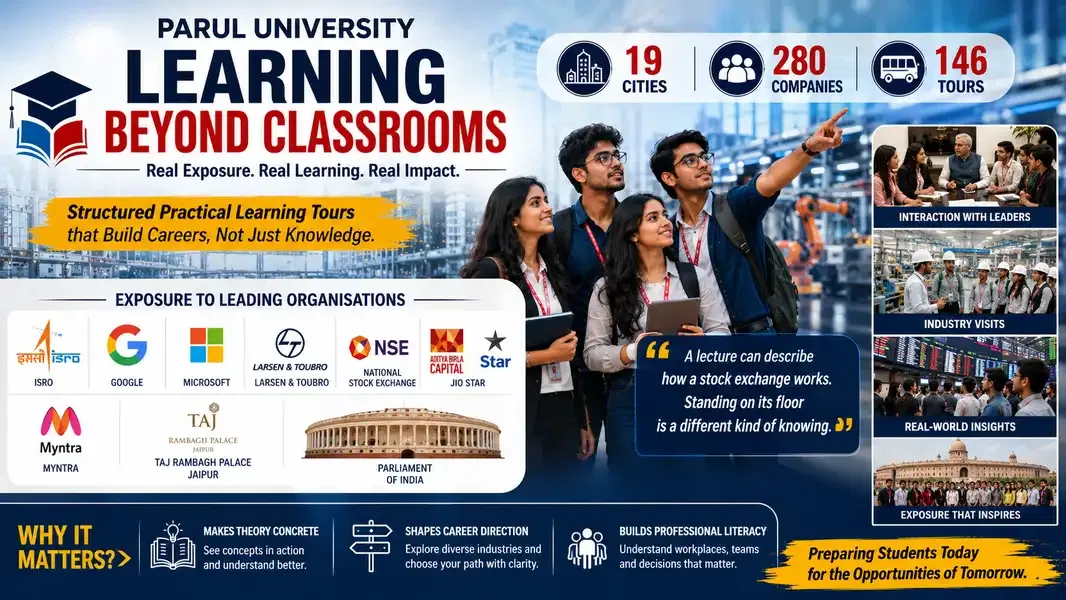
Table of Contents
Parul University Practical Learning Tours: 280 Companies, 19 Cities, and Why Exposure Matters!
There is a limit to what a classroom can convey about the working world, and it is reached quickly. A lecture can describe how a stock exchange functions, how a spacecraft is assembled, or how a manufacturing line operates, but a description is not the same as standing in the room. The gap between the two is where a great deal of employability is built.
Parul University addresses that gap through structured practical learning tours, a programme that has reached 280 companies across 19 cities through 146 tours. This guide sets out what the programme covers, why experiential exposure is one of the more useful and least discussed elements of an undergraduate education, and how a prospective student can tell a genuine experiential model from a decorative one when comparing institutions.
The Scale of the Programme
The figures describe a programme run at scale rather than an occasional field trip.
- 19 cities across India: Exposure to industry in multiple regions and sectors, rather than only those near campus.
- 280 companies: A breadth of organisations spanning technology, manufacturing, finance, media, and government.
- 146 tours: A sustained programme, not a one-off event, indicating that industry exposure is built into the academic model rather than added to it. The repetition across years is what turns exposure into a habit of professional observation rather than a single memorable day.
The organisations reached illustrate the range. They include the Indian Space Research Organisation, Google, Microsoft, Larsen and Toubro, the National Stock Exchange, Aditya Birla Capital, Jio Star, Myntra, the Taj Rambagh Palace in Jaipur, and the Parliament of India. A programme that spans a space agency, a technology multinational, a stock exchange, a luxury hospitality property, and the national legislature is providing genuinely diverse exposure, of a kind few institutions can arrange even once, let alone as a sustained programme.
“A lecture can describe how a stock exchange works. Standing on its floor is a different kind of knowing.”
Why Experiential Exposure Changes a Student!
Industry exposure does something a curriculum alone cannot, in three specific ways.
- It makes theory concrete: A concept understood abstractly in a lecture becomes memorable and usable once a student has seen it operating at scale in a real organisation.
- It shapes career direction: Many students do not know which part of an industry they want to enter until they have seen several. Exposure to a range of organisations helps a student choose with information rather than assumption.
- It builds professional literacy: Understanding how a real workplace functions, how teams operate, how decisions are made, is a form of preparation that no examination assesses but every employer values.
This is why experiential learning appears repeatedly in discussions of graduate employability. A student who has stood on a manufacturing floor, observed a trading operation, or seen a research organisation at work arrives at a first job with a frame of reference that a purely classroom-taught graduate lacks.
Exposure to Leaders, Not Only Organisations!
Alongside site visits, Parul University's educational tours give students the opportunity to interact with senior figures from industry, government, and public life. The value of this is not the meeting itself but the perspective it transfers: hearing directly from someone operating at the top of a field reframes what a student believes is possible.
The figures students have engaged with through these programmes span government, industry, finance, and the professions, including senior figures from national institutions and major corporations. For a student, exposure of this kind is a form of horizon-expansion that is difficult to arrange individually and valuable precisely because it is rare. A conversation with someone who has built or led an organisation conveys something no textbook does: a sense of how a career is actually assembled, decision by decision, over years.
The Difference Between a Visit and a Tour Programme
It is worth distinguishing a structured practical learning programme from the occasional industrial visit that most institutions arrange. The difference is not semantic; it changes what a student receives.
An occasional visit is a single day, loosely connected to coursework, often arranged late and remembered as an outing. A structured programme, by contrast, is planned as part of the academic model, matched to what students are studying, and repeated across the years of a degree. The figure of 146 tours reaching 280 companies describes the second kind: a sustained commitment rather than an annual excursion.
For a prospective student, the question to ask any university is therefore not whether it arranges industrial visits, because nearly all claim to, but how many, how often, to what calibre of organisation, and whether they are integrated with the curriculum. The specifics separate a genuine experiential model from a line in a brochure.
Sector Breadth and Why It Matters.
The range of organisations in the programme is as significant as the number. Exposure confined to a single sector teaches a student about one industry; exposure across many teaches them where they fit.
A programme spanning a space agency, technology multinationals, a stock exchange, manufacturing and engineering firms, media organisations, a luxury hospitality property, and the national legislature gives students from many disciplines relevant exposure, and gives every student a sense of the wider economy their field sits within. For a student uncertain of their direction, which describes most students, that breadth is precisely what helps them choose.
How This Connects to Outcomes
Industry exposure is not an end in itself; it feeds directly into employability and placement. A student who has seen how organisations operate interviews better, chooses a career direction earlier, and adapts faster to a first role. Parul University's placement ecosystem comprises more than 2,200 recruiting companies, and the practical learning tour programme is part of the preparation that supports it, discussed further in the guide to reading a placement report and through the Training and Placement Cell.
For a prospective student comparing universities, the practical question is simple: does the curriculum leave the classroom, how often, and to what kind of organisation. Structured, large-scale industry exposure is a meaningful differentiator, and it is one worth asking any institution to describe in detail.
Exposure That Supports Every Discipline
A final point is worth making about breadth of discipline. Practical learning is sometimes assumed to benefit engineering and management students alone, but the programme's range shows otherwise.
A design student benefits from seeing a manufacturer or a media house; a law student from observing the national legislature; a hospitality student from a luxury property; a science student from a research organisation. Structured exposure serves the full range of a university's disciplines, provided the programme is diverse enough to reach them, which a span of 280 companies across sectors is designed to do. For a prospective student in any field, the relevant question is whether the programme reaches organisations relevant to their own discipline, and a programme of this breadth generally does.







POST YOUR COMMENT