
Dr. Mange Ram Yadav of Parul University holds an h-index of 36 and an i10-index of 101, and appears in the Stanford-Elsevier global top 2% of scientists, in medicinal chemistry.
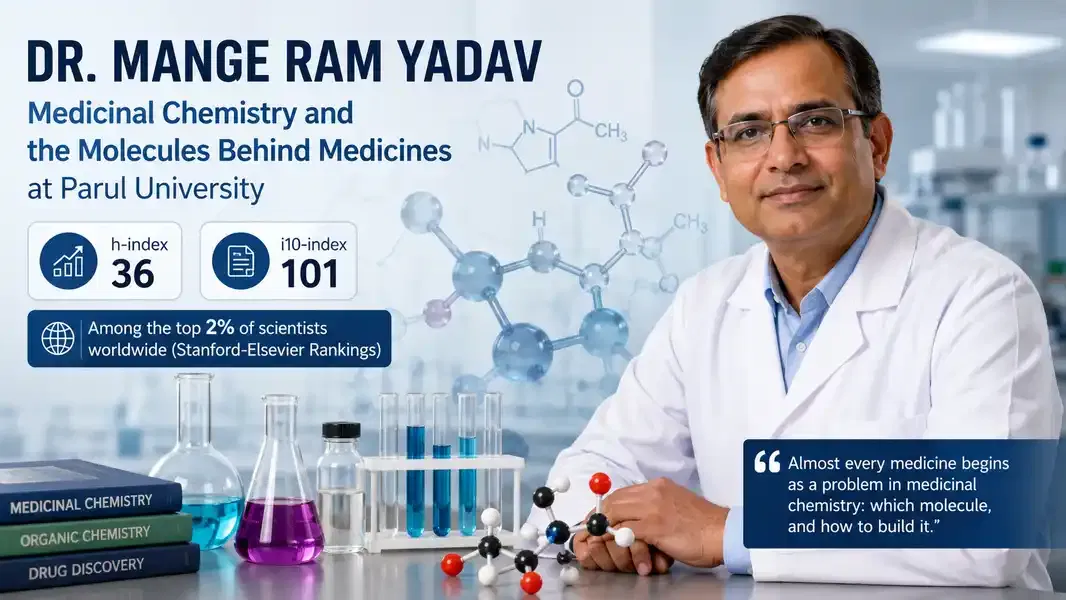
Table of Contents
Dr. Mange Ram Yadav: Medicinal Chemistry and the Molecules Behind Medicines at Parul University
Dr. Mange Ram Yadav is a Senior Professor of Research in Parul University's Faculty of Pharmacy, with an h-index of 36 and an i10-index of 101, and he appears in the Stanford-Elsevier global rankings of the top two percent of scientists. An i10-index of 101 means at least 101 of his papers have each been cited ten or more times.
His recorded fields are medicinal and biomolecular chemistry, and organic chemistry, disciplines that sit at the origin of the pharmaceutical process, before a drug is formulated or delivered, at the point where the molecule itself is designed. An i10-index of 101 alongside an h-index of 36 describes a researcher whose work has been both extensive and consistently drawn upon by others in the field.
The Expertise: Medicinal Chemistry
Medicinal chemistry is the discipline that designs and synthesises the chemical compounds that become drugs. It asks which molecular structures will interact with a biological target, how they can be built, and how they can be modified to be more effective and less harmful. Almost every medicine begins as a problem in medicinal chemistry.
Organic and biomolecular chemistry provide the tools: the reactions by which complex molecules are assembled, and the understanding of how those molecules behave in a living system. It is foundational work, and a research group with strength in it gives a pharmacy faculty a capability that reaches back to the very start of drug development.
“Almost every medicine begins as a problem in medicinal chemistry: which molecule, and how to build it.”
What the Record Indicates
An h-index of 36, sustained across a career, indicates a researcher whose work has been consistently cited by others in the field. For a student, the presence of such a researcher signals a department engaged with fundamental pharmaceutical research rather than only with teaching an established syllabus.
Dr. Yadav is one of several Faculty of Pharmacy researchers at Parul University who appear in the Stanford-Elsevier rankings, a concentration examined in the guide to pharmacy at Parul University.
For a prospective postgraduate student in particular, a supervisor working in medicinal chemistry with a strong citation record is a direct route into one of the most fundamental areas of pharmaceutical science.
Medicinal chemistry is foundational work: a faculty strong in it reaches back to the very start of drug development.
Where Medicinal Chemistry Sits in the Drug Pipeline
It helps to see where this work sits in the larger process. The development of a medicine runs, broadly, from identifying a biological target, to designing a molecule that acts on it, to testing that molecule, to formulating and delivering it as a usable drug.
Medicinal chemistry occupies the second of those stages, the design and synthesis of the molecule itself, which is why it is described as foundational. A faculty with strength here, alongside colleagues working in drug delivery and pharmacology, covers the pipeline from the molecule to the medicine. That combination is what makes a pharmacy faculty genuinely research-led rather than strong in a single narrow area.
How to Verify This Yourself
The citation record behind this profile is public and directly checkable.
- Search the name: Dr. Mange Ram Yadav's publications and citation counts appear in public citation databases.
- Check the Stanford-Elsevier release: The openly published dataset can be searched for his name.
- Read the recorded fields: Medicinal chemistry, biomolecular chemistry, and organic chemistry, and consider whether they match your intended area of study.
A named researcher whose record can be independently confirmed is worth more to a decision than any general assurance about faculty quality.
A Note on What the Metrics Do Not Say
A citation record measures the reach of published work. It does not measure teaching or mentorship, which a prospective student should assess separately by speaking with current students where possible.
The value of naming a researcher and their verifiable metrics is that it converts a vague claim, a strong faculty, into a specific one that can be checked. That is the entire purpose of these profiles: not to assert quality, but to point to evidence a family can examine for themselves.
Why Fundamental Research Underpins Everything Downstream
There is a tendency to value applied research over fundamental research, on the assumption that the applied kind is closer to a usable result. In pharmacy, that assumption misleads. Every applied advance in medicine rests on fundamental work done earlier, often decades earlier, in exactly the kind of medicinal and organic chemistry Dr. Yadav's field represents.
A faculty that maintains strength in fundamental chemistry, rather than only in downstream application, is investing in the foundation the rest of the discipline is built on. For a student who wants to understand medicines at their origin rather than only their use, a research group of this kind is where that understanding begins.

















POST YOUR COMMENT