
Dr. Deep Pooja of Parul University holds an h-index of 37 and appears in the Stanford-Elsevier global top 2% of scientists, in polymers and drug delivery systems research.
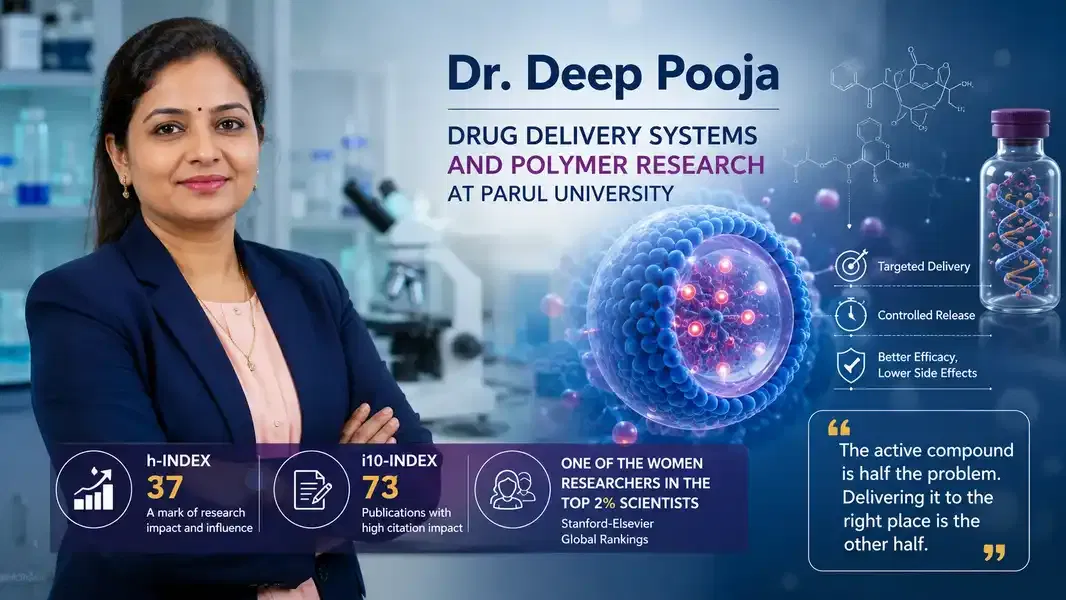
Table of Contents
Dr. Deep Pooja: Drug Delivery Systems and Polymer Research at Parul University
Dr. Deep Pooja is an Associate Professor of Pharmaceutical Sciences in Parul University's Faculty of Pharmacy, with an h-index of 37 and an i10-index of 73, and she appears in the Stanford-Elsevier global rankings of the top two percent of scientists. Her recorded fields are pharmacology and pharmacy, polymers, and drug delivery systems.
She is also one of the women researchers among Parul University's seven Stanford-Elsevier-listed scientists, representing the highest tier of research, which is, in itself, a measurable and uncommon achievement. An h-index of 37, sustained over her research career, places her firmly among established, widely cited scientists in her field.
The Field: Drug Delivery Systems
A drug delivery system is the mechanism by which a medicine reaches its target in the body. The active compound is only half the problem; the other half is delivering it to the right tissue, at the right concentration, releasing over the right period, while sparing the rest of the body. Poor delivery can render an effective compound useless, or a safe one harmful.
Polymer science is central to this. Engineered polymers can encapsulate a drug, protect it as it travels through the body, and release it in a controlled way at its destination. This is among the most active and consequential areas of contemporary pharmaceutical research, underpinning controlled-release medicines and targeted therapies.
The active compound is half the problem. Delivering it to the right place is the other half.
What the Record Indicates
An h-index of 37 with an i10-index of 73 describes a researcher whose work is well established and widely cited in her field. For a student, it signals an active research group in one of pharmacy's most important contemporary areas.
Dr. Pooja's work sits within a Faculty of Pharmacy that contributes several names to the Stanford-Elsevier rankings, a research concentration examined in the guide to pharmacy at Parul University. Her presence also features in the university's record on gender equality, where women researchers in the global top two percent are a concrete indicator, discussed in the article on Parul University's SDG 5 ranking.
For a prospective pharmacy student, and particularly for young women considering a research career in the sciences, a visible, highly cited woman researcher on the faculty is a signal that such a career is possible there.
Why Delivery Is as Hard as Discovery
It is tempting to assume that discovering a drug is the difficult part and delivering it a technicality. The opposite is frequently true. Many promising compounds fail not because they do not work, but because they cannot be delivered to their target safely and effectively.
A drug that degrades before it arrives, that cannot cross the barrier it needs to, or that spreads through the whole body when it should act on one tissue, is a failed medicine regardless of how well it performs in a test tube. This is why drug delivery research is not a supporting discipline but a central one, and why a faculty with strength in it is addressing one of the field's genuine bottlenecks.
How to Verify This Yourself
The metrics are public and independently checkable, as they should be.
- Search the name: Dr. Deep Pooja's citation record is available through public citation databases.
- Check the Stanford-Elsevier dataset: openly published and searchable by name and institution.
- Match the field: drug delivery and polymer science, and whether they align with a student's intended focus.
A verifiable researcher on the faculty is a fact a family can check for themselves, which is worth more than any claim that cannot be.
A Note on What the Metrics Do Not Say
It should be said plainly that citation metrics measure research influence alone. They do not capture teaching quality or the experience of being supervised, which vary between individuals and which a prospective student should assess directly.
What the metrics establish, reliably, is that the research is real and respected in its field. For a student choosing where to study, that is one important input among several, offered here precisely because it can be independently verified rather than merely asserted.
Representation as a Practical Signal, Not Only a Principle
The presence of a highly cited woman researcher on a science faculty is often discussed as a matter of principle, and it is one. It is also a practical signal for a prospective student, and worth reading as such.
A department in which women reach the highest tier of research is, demonstrably, a department in which women are supported to do so. For a young woman weighing a research career, that is evidence about the environment she would be entering, drawn from an outcome rather than a policy statement. Dr. Pooja's standing is, in that sense, information as much as it is achievement.




















POST YOUR COMMENT