
Dr. Prince Jain of Parul University holds an h-index of 21 and appears in the Stanford-Elsevier global top 2% of scientists in mechatronics, ICT, and applied physics.
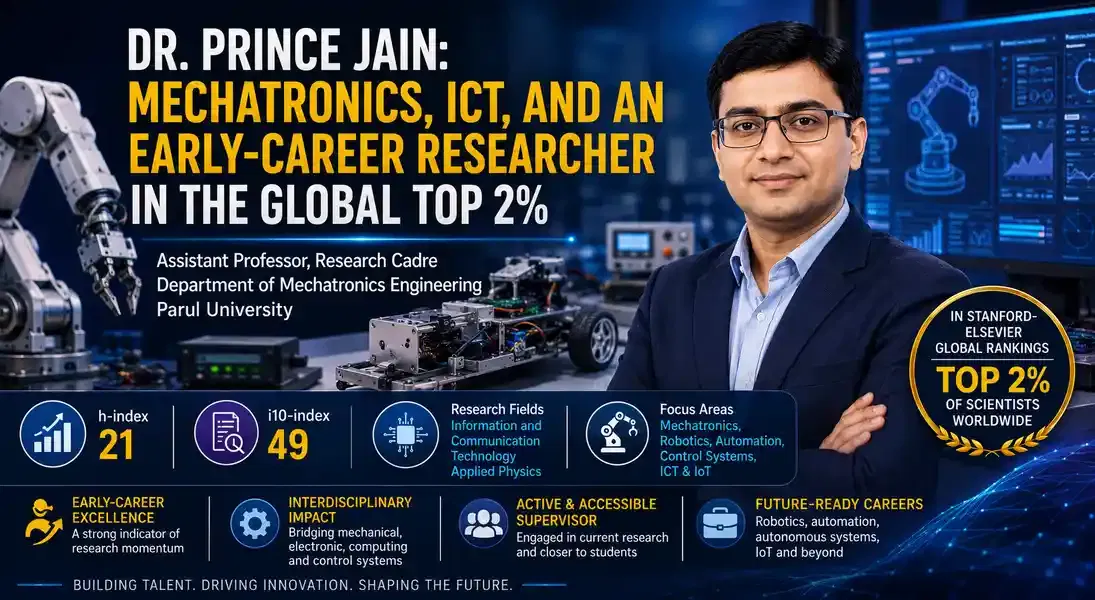
Table of Contents
Dr. Prince Jain: Mechatronics, ICT, and an Early-Career Researcher in the Global Top 2%
Dr. Prince Jain is an Assistant Professor in the Research Cadre of the Department of Mechatronics Engineering at Parul University's Faculty of Engineering and Technology, with an h-index of 21 and an i10-index of 49, and he appears in the Stanford-Elsevier global rankings of the top two per cent of scientists. His recorded fields are information and communication technology and applied physics.
His profile is worth noting for a particular reason: as an Assistant Professor, he is among the earlier-career researchers on the list, which indicates a research culture producing new talent rather than resting on established names.
The Significance of an Assistant Professor on the List
The Stanford-Elsevier list skews, unsurprisingly, toward senior researchers, because citation metrics accumulate over decades. An Assistant Professor reaching it has produced a body of highly cited work relatively early, which is a strong indicator of research momentum.
For a university, an early-career researcher on such a list is arguably a more telling signal than a senior one. It suggests an environment where new researchers are supported to produce influential work, rather than a single distinguished hire whose reputation was built elsewhere.
An early-career researcher on the list signals a system producing talent, not a single reputation built elsewhere.
The Field: Mechatronics and ICT
Mechatronics is the integration of mechanical engineering, electronics, computing, and control, the discipline behind robotics, automated systems, and intelligent machines. Information and communication technology, one of Dr. Jain's recorded fields, provides the computational and networking foundations these systems depend on.
It is an inherently interdisciplinary field, and a fast-moving one, sitting at the centre of automation, robotics, and the connected systems that increasingly define modern engineering. Research strength here connects directly to the technologies students will build their careers around.
What This Means for a Student
For a prospective engineering student, an early-career researcher with a strong citation record is a supervisor who is both active and accessible, engaged with current work and earlier in a career that a student can be part of. Parul University's engineering research is supported by an estate of more than 250 technology laboratories, described on the Parul University blog.
The presence of researchers like Dr. Jain indicates a department where research is a living, growing activity, which is precisely the environment a research-minded student should seek.
Interdisciplinary Fields and Career Range
One practical advantage of an interdisciplinary field like mechatronics is the range of careers it opens. A researcher and their students work across mechanical systems, electronics, computing, and control, which means the skills developed apply to robotics, automation, automotive systems, manufacturing, and the connected devices of the Internet of Things.
For a student, working under a researcher in such a field builds a portfolio that is not tied to a single narrow industry. That breadth is increasingly valuable as engineering roles themselves become more interdisciplinary, and it is a reason to seek out research-active supervisors in integrative fields specifically.
How to Verify This Yourself
As with every profile in this series, the underlying metrics are public.
- Search the name: Dr Prince Jain's citation record is available through public citation databases.
- Check the Stanford-Elsevier dataset: Openly published and searchable by name and institution.
- Consider the career stage: An early-career researcher on the list is a supervisor who is both active and likely to be accessible to students.
A verifiable early-career researcher is one of the more encouraging signals a prospective student can find, because it speaks to where a department is heading rather than only where it has been.
A Note on What the Metrics Do Not Say
As with any researcher, citation metrics describe influence, not teaching. A prospective student should assess mentorship and classroom quality separately, ideally by speaking with current students.
What an early-career researcher on a global list does establish, objectively, is research momentum, work that others in the field are already citing. That is a fact drawn from independent data, and it is offered here as exactly that, a verifiable signal rather than a claim.
Robotics, Automation, and Where the Jobs Are Going
Mechatronics sits at the centre of several of the fastest-growing areas of engineering employment: industrial automation, robotics, autonomous systems, and the connected devices of the Internet of Things. These are not speculative fields; they are where a large share of new engineering roles is being created.
For a student, studying under a research-active mechatronics faculty means exposure to the integrative thinking these fields demand, combining mechanical, electronic, and software systems into working wholes. A supervisor engaged in current research in the area is a direct connection to the skills those roles require, which is a concrete reason the research activity of a department matters to a student's employability, not only to its reputation.



















POST YOUR COMMENT